
Deck Screws Complete Guide: Types, Applications & Selection
Choosing the right lumber and laying boards straight aren't enough to build a deck that lasts. The fasteners you choose determine whether that deck stays solid for fifteen years or starts wobbling after three seasons.
Decks exposed to the elements endure relentless punishment: the summer heat, the winter freeze, heavy rain, UV radiation, and humidity. Fasteners that are installed indoors can fail under these conditions. Rust forms. Boards loosen. Screws back out. What looked like a solid deck begins to feel unsafe underfoot.
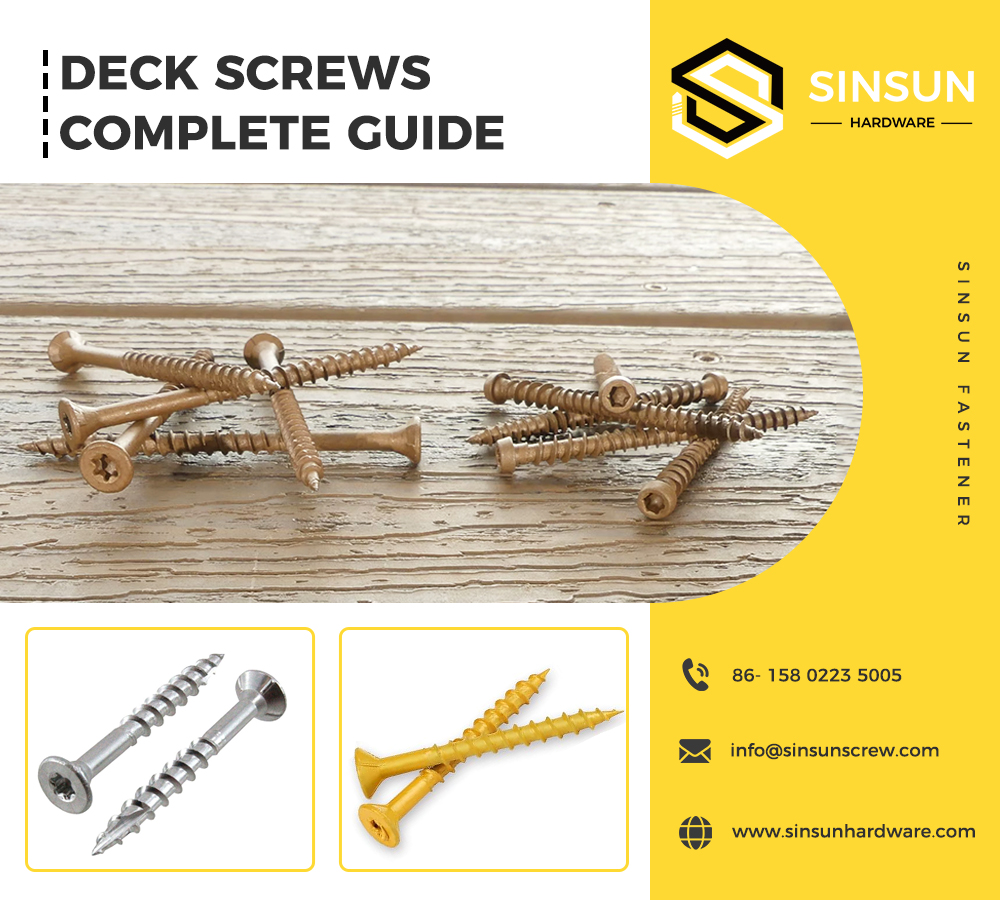
Not all deck screws serve the same purpose. It is important to choose the right fasteners for each type of decking material, installation environment, and project budget. In this guide, we will discuss three types of deck screws you can use in modern outdoor construction: wood deck screws, coated deck screws, and composite decking screws.
Deck Screws vs Ordinary Wood Screws – What's the Real Difference?
It is tempting to use leftover interior wood screws for an outdoor deck project, but it is important to consider whether or not this is the best approach. This is an error that manifests after two years.
Generic wood screws lack three critical features for outdoor applications:
Weather-resistant coatings. Interior wood screws have minimal rust protection. Outdoor decks face rain, snow, and humidity year-round. Without proper coating, standard screws rust, stain deck boards, and lose holding power.
Anti-backdoor thread design. As deck boards expand and contract with seasonal temperature changes, standard wood screws gradually loosen. In order to prevent seasonal loosening, deck screws are designed with thread profiles that grip wood and composite materials more firmly.
Optimized head and tip geometry. Deck screws feature underhead cutting ribs for easy countersinking and flush finish. Sharp points and notched threads reduce driving friction. Due to their lack of design details, standard wood screws often split boards or sit unevenly.
The use of interior wood screws outdoors leads to costly repairs. Professional deck screws are designed specifically for exterior use, making them the perfect choice for securing your deck to the ground.
Wood Deck Screws – The Standard Choice for Traditional Timber Decks
Wood deck screws are the most common fasteners used for traditional outdoor decking. They are made for pressure-treated lumber, cedar and other solid wood deck materials.
Sharp thread pitches and tapered tips bite cleanly into dense exterior wood, splitting the board surface without splitting the board surface.
Partial thread designs allowing secure clamping of a plurality of elements together without separation.
Underhead cutting ribs for easy countersinking and a neat flush finish.
Reduced friction in driving through notched thread profiles and wax coatings.
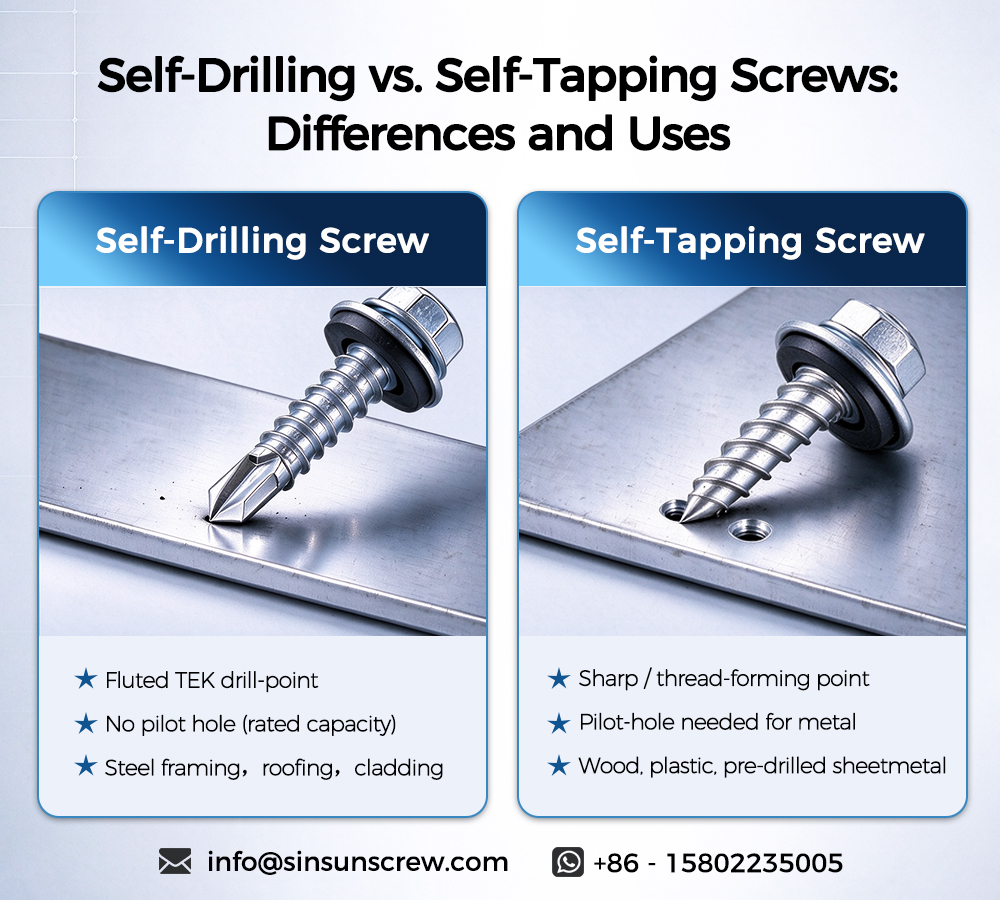
Featuring Type 17 auger points that self tap into decking materials.
Protective Coatings - Most wood deck screws come with premium protective coatings to help defend against daily moisture and mild weathering in inland, low-humidity climates. Their balanced clamping force holds solid wood boards tight against support joists, minimizing movement from routine temperature and humidity shifts.
Coated Deck Screws – The Upgrade for Enhanced Corrosion Resistance
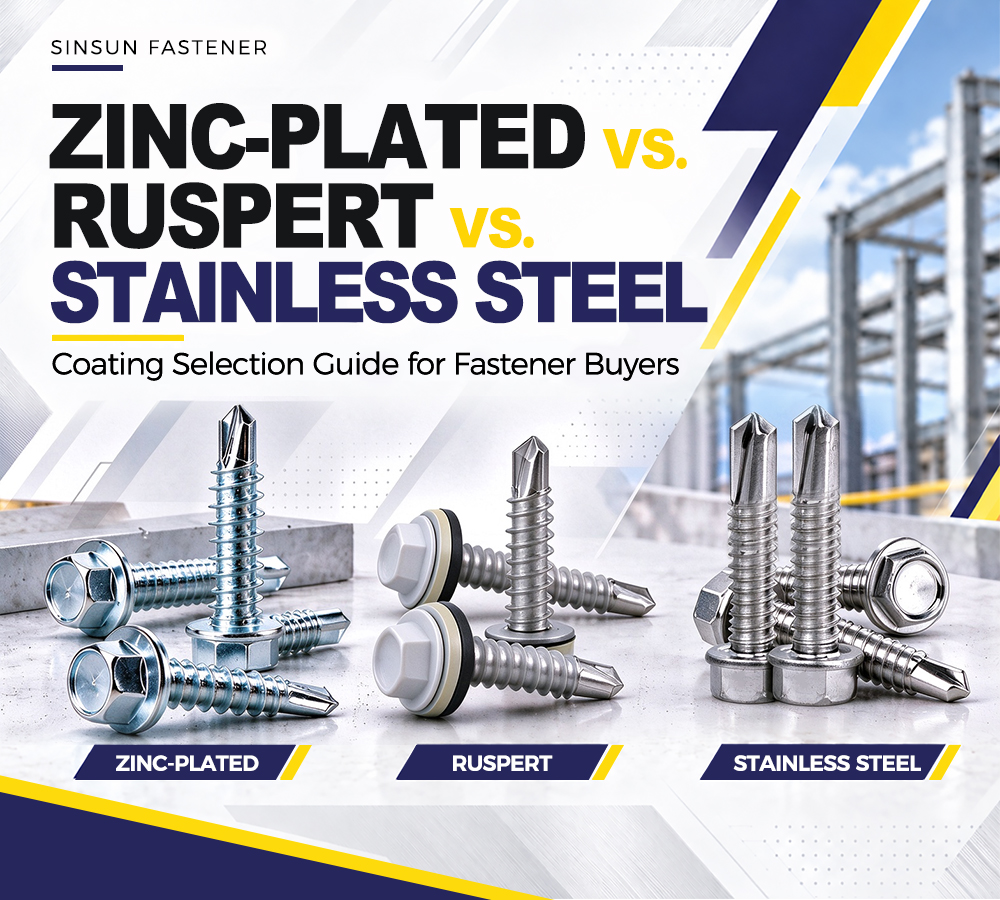
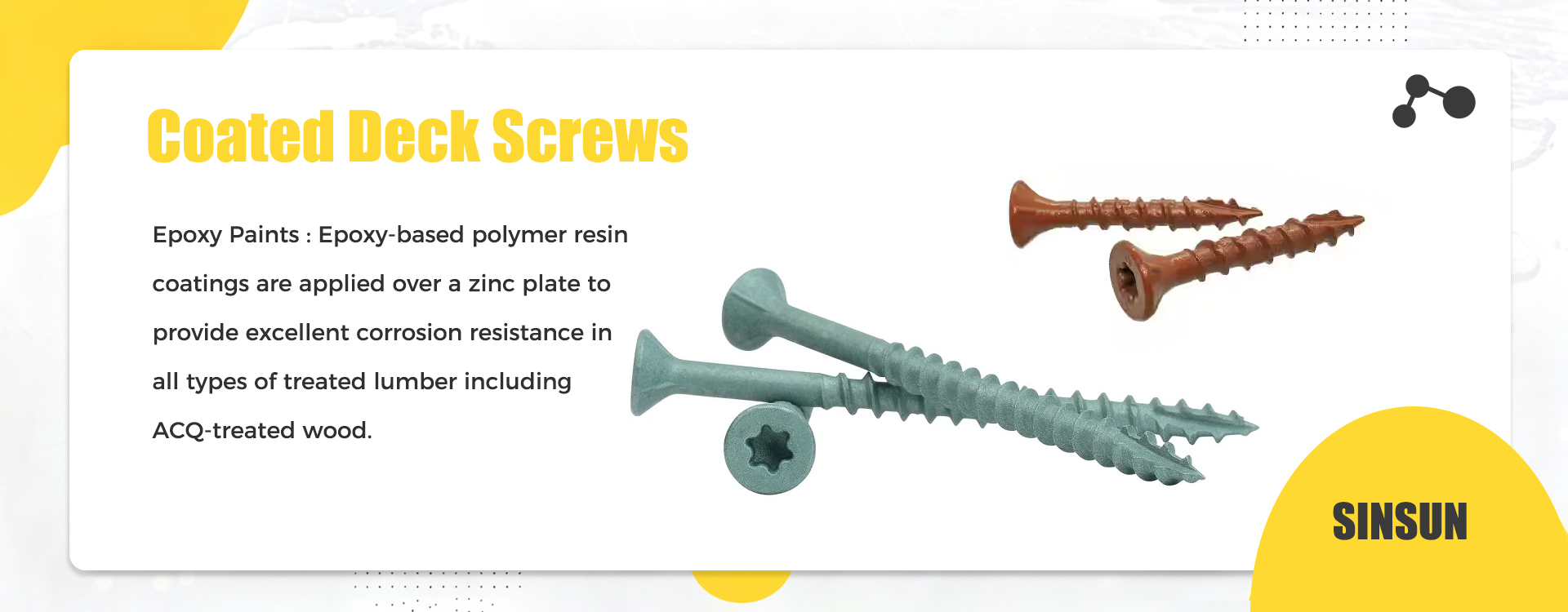
Coated deck screws fill the gap when regular wood deck screws require a little extra protection, but stainless steel is overkill. The fasteners feature a hardened carbon steel core and advanced coating systems that provide superior corrosion resistance at a fraction of the cost of stainless steel.
Coating types explained:
Epoxy Paints. Epoxy-based polymer resin coatings are applied over a zinc plate to provide excellent corrosion resistance in all types of treated lumber including ACQ-treated wood. Epoxy-coated screws are steel fasteners that are coated with a durable, corrosion-resistant polymer resin that provides strong adhesion and protection even after the screw is driven into wood or composite materials.
Ceramic coat. Premium ceramic coatings are multilayered in terms of protection. They feature a zinc layer, a chemical adhesion layer, an epoxy coating and a durable protective finish. Certain ceramic-coated screws are backed by a 10-year guaranty against rust and corrosion. Other manufacturers go further, with five layers of protection from sun, temperature, rain, snow, tree sap and bird droppings.
Key advantage: Coated deck screws are usually 3-5 times cheaper than stainless steel on a per-unit basis, so they’re a smart choice for treated softwood decks in normal outdoor situations.
Limitation: Coatings are great for protection, but they can get scratched during installation, exposing the carbon steel underneath. If you’re in a coastal environment or any place where moisture is regularly present, stainless steel is still the best bet.
Composite Decking Screws – Engineered for Modern Composite Boards
Low maintenance, fade resistance and long service life have made composite decking a top choice for modern outdoor construction. But composite boards have unique physical properties—they are denser, more brittle and more susceptible to surface cracking and “mushrooming” than natural wood.
Standard wood deck screws can either damage composite materials when installing them or fail to hold up over time. For these projects you are required to use dedicated composite decking screws.
The increasing problem: When a screw is driven into composite material, the fibrous core material can be augered upward within the bore causing the surface to bulge upward. This makes for an ugly bump around the screw head and ruins the smooth appearance of the deck.
How composite decking screws solve this:
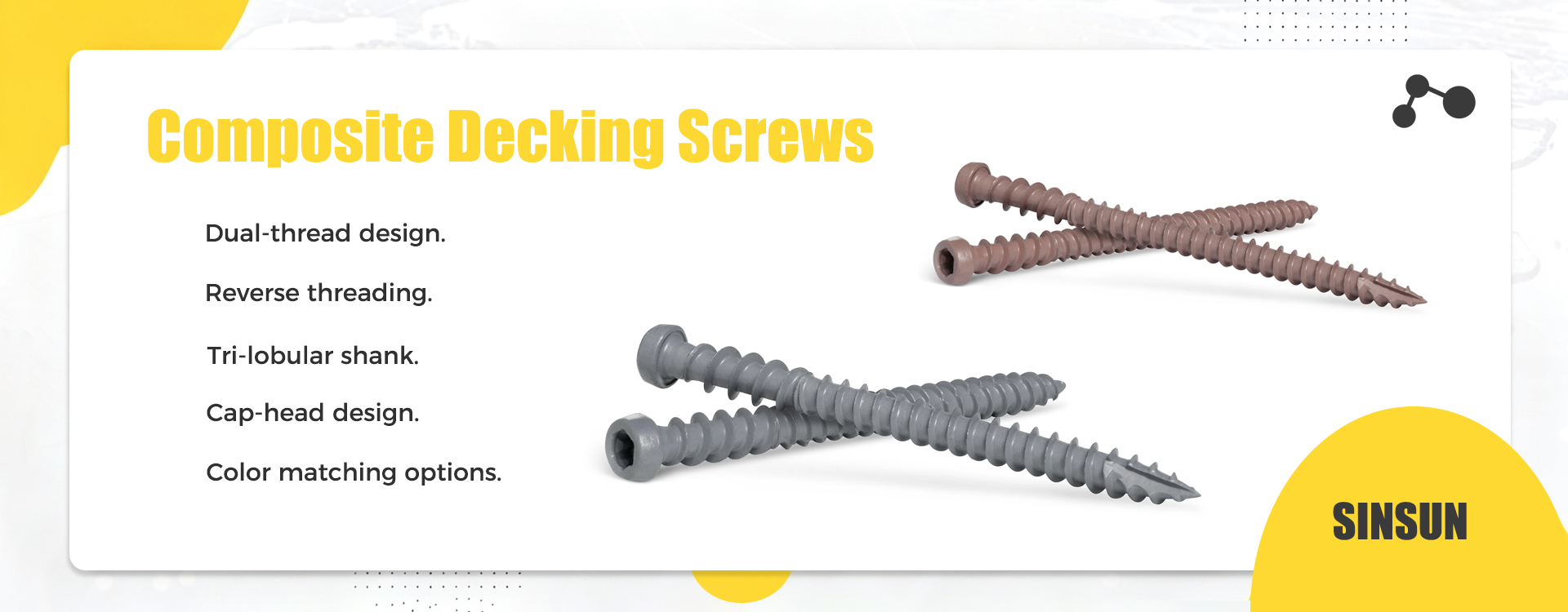
Double-thread design. These screws have a dual thread design so they don’t mushroom when being installed. The five sided thread displaces less deck material and reduces driving torque by over 23% over comparable screws.
Reverse threading. Reverse threading under the head pulls material downward instead of pushing it upward, avoiding mushrooming and other surface imperfections.
Tri-lobular shank. The tri-lobular thread design minimizes damage to the composite board during driving. This unique shank geometry cuts clean through dense composite material without tearing or bulging.
Cap-head design. Cap-head, and inverted upper threads work together to prevent mushrooming. The cap head is flush so sits flush with the deck surface for a clean professional finish.
Color matching options.. Many composite decking screws come in colors to match popular deck board finishes, providing a seamless, near-invisible fastening.
Key advantage: Composite decking screws are designed to avoid the damage that regular screws cause to composite materials, providing long-term structural integrity and a professional look.
Which Deck Screw Is Right for You?
| Feature | Wood Deck Screws | Coated Deck Screws | Composite Decking Screws |
| Base Material | Carbon steel | Hardened carbon steel | Carbon steel or stainless |
| Protection | Basic coating | Multi-layer epoxy or ceramic coating | Varies by brand |
| Primary Advantage | Cost-effective standard choice | Superior corrosion protection at moderate cost | Prevents mushrooming and surface damage |
| Best Environment | Inland, normal weather | Inland with treated lumber, moderate moisture | Composite decking materials |
| ACQ Compatibility | Limited | Yes (most coated options) | Varies, check specification |
| Cost | Low-Moderate | Moderate | Moderate-High |
| Installation | Standard | Standard | Specialized (reduced torque, color-matched) |
How to Choose the Right Deck Screw ?
Step 1: Identify Your Decking Material
Solid wood (PT pine, cedar, redwood) → Wood Deck Screws or Coated Deck Screws
Composite decking (Trex, TimberTech, etc.) → Composite Decking Screws
Step 2: Assess Your Environment
| Environment | Recommended Screw |
| Inland, mild climate | Wood Deck Screws or Coated Deck Screws |
| Inland with treated lumber | Coated Deck Screws (ACQ-compatible) |
| Coastal, high humidity, consistent moisture | Coated Deck Screws (premium) or Stainless Steel |
| Extreme marine/coastal | Stainless Steel (not covered in this guide) |
Step 3: Consider Your Budget
| Budget Level | Recommendation |
| Lowest cost | Wood Deck Screws |
| Best value for mid-range | Coated Deck Screws |
| Premium | Composite Decking Screws (for composites) |
Step 4: Check Installation Requirements
Pre-drilling: Hardwoods and dense composites often require pre-drilling to prevent splitting or mushrooming. Some composite decking screws are designed to eliminate pre-drilling in most applications.
Drive type: For coated screws, Torx or star drive (T-25) provides lots of points of contact and reduces cam-out. Square drive is also excellent for high torque and minimal slippage.
Frequently Asked Questions
Q1: Can I use regular wood screws for outdoor decking?
You can, but you will regret it. Regular wood screws are not made for outdoor conditions.They quickly succumb to rust, become loose over time, and result in stained deck boards and loose joints. However, by the time you realise there is an issue, you will have a lot of work to put right. Avoid the hassle and use proper deck screws.
Q2: What is the difference between wood deck screws and composite deck screws?
The wood deck screws are designed to provide a strong, deep hold in solid timber. Composite deck screws, on the other hand, are designed to penetrate dense, brittle composite boards without cracking them or creating mushroom bumps. They also help prevent surface damage from standard screws. Different materials, different screws.
Q3: Can I use stainless steel deck screws if I'm not near the coast?
No, not necessarily. Deck screws that are coated will work fine on an inland deck that doesn't get wet all the time. Stainless steel is worth it if your deck stays damp - shaded areas, high humidity, or where it doesn't dry out quickly. The product will last longer and require less maintenance.
Q4: Do I need to pre-drill composite decking screws?
Most composite deck screws are designed to go in without pre-drilling, but check the product spec to be sure. Some composites are harder than others, and pre-drilling can help prevent mushrooming on the surface. When in doubt, test on a scrap piece first.
Q5: Is it possible to use composite decking screws on wood decks?
They cost more and do not grip wood like a proper wood screw. Composite screws are made for composite materials. For a wood deck, stick with wood deck screws or coated deck screws. They cost less and perform better.
Q6: How long do coated deck screws last?
Rust warranties are often offered with quality coated screws. There are several factors that determine how long these products will last in the real world, including the local climate and the quality of installation. The lifespan of these plants can be much longer in a dry inland area, for example. They might not last for a decade if moisture and humidity levels are high.
Final Conclusion
Deck screws are the invisible backbone of every outdoor deck structure. Matching the right screw type to your project is the simplest way to guarantee long-term durability.
| Your Project | Best Screw Choice |
| Standard wood deck, inland location | Wood Deck Screws |
| Wood deck with treated lumber | Coated Deck Screws |
| Composite decking | Composite Decking Screws |
| Coastal or high-moisture location | Coated Deck Screws (premium) or Stainless Steel |
Wood Deck Screws serve traditional timber decks well for regular inland use. Coated Deck Screws provide an upgrade path for projects requiring enhanced corrosion resistance without the premium cost of stainless steel. Composite Decking Screws protect modern composite materials from installation damage and long-term surface imperfections.
By prioritizing scenario-based screw selection instead of generic fastener use, builders can avoid the most common deck failures, reduce future repair costs, and build safer, more durable outdoor deck spaces.